

It might just be that the mid-terms just wrapped up. Or, it might be that we’re getting closer to 2032. If that date doesn’t hold any significance to you, it’s been the long running projection on when Social Security (specifically the Old-Age and Survivors Insurance trust fund) runs out of money. At that point, we won’t have enough income coming in via payroll taxes to pay the entirety of benefits that are owed. So the question is, should you worry or should you change your plans?
Key Takeaways
- We’ve been here before, and the changes bought us roughly 50 years of solvency
- There are a number of simple proposals that could add more solvency beyond our lifetimes
- For those at or near retirement, it probably doesn’t make sense to alter your current plans
Some Background on Social Security
It’s worth talking about how Social Security works. Workers in the United States pay into the Social Security system through payroll taxes on earned income (also known as FICA). This is 6.2% that goes directly into Social Security (your employer matches it) and another 1.45% that goes to Medicare Part A. The Social Security portion is capped at $184,500 per year. So, if you make over that, you only pay into Social Security on your first $184,500 of earnings in 2026.
Social Security benefits are determined based on your highest 35 years of earnings. Your highest 35 years of earnings are averaged out, indexed for wage growth to create your Averaged Indexed Monthly Earnings or AIME. This amount is run through a weighted formula to create your Primary Insurance Amount (PIA). The PIA is what you’re eligible for at your Full Retirement Age (you can view those here). For now, Full Retirement Ages run between 66-67 depending on the year you were born.
Of course, you can claim your benefits early at age 62, or any year between then and age 70. Past your Full Retirement Age, you receive 8% per year in delayed retirement credits on your benefit amount. This stops at age 70. There are no credits for claiming past age 70.
Social Security was a program built on two components, the income it receives from payroll taxes, and the trust fund. There is a good bit of controversy on whether there is a trust fund. There is. It is invested in specially issued Treasury bonds that do not trade on the public market. Since 2010, the amount of benefits being paid out has exceeded the non-interest income. Said another way, we’ve been paying out more than we’re bringing in. You can see a chart of that below.
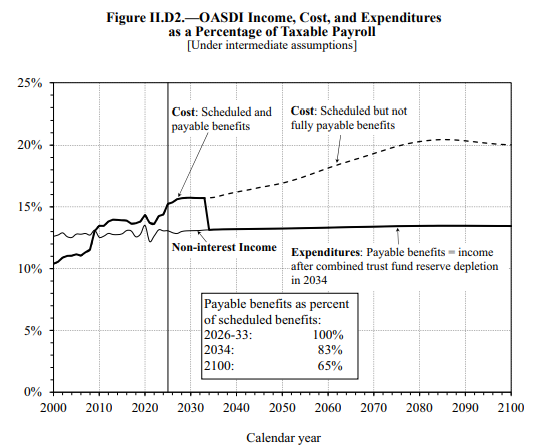
That has resulted in the spend-down of the trust fund. As of the latest report in 2026 (viewable here), the trust fund is expected to deplete in 2032. At that point, the benefits being paid out can only be paid by one source – the amount of taxes that come in.
The forecast is that at that point income received from payroll taxes will only cover roughly 78% of benefits owed. In that scenario, there would likely be a benefit cut across the board to all recipients.
You may also see 2034 floating around. That’s the date if Congress merges the retirement trust fund with the disability trust fund, which is in much better shape. That would buy two more years and soften the cut, but it isn’t automatic. It takes an act of Congress, which brings us back to the theme of this whole post. With the mid-terms behind us, this issue is moving to the front burner.
How did we get here?
It’s worth talking about “how” this happened. The immediate answer is the last time we had meaningful Social Security reform was in 1983. That is when the Full Retirement Age was raised from 65 to 67, delayed retirement credits were increased (eventually to the 8% per year), benefits became taxable for the first time, and these changes were expected to increase the solvency of the program for 75 years.
It’s also worth pointing out that not all of the 1983 pain landed on younger workers. Retirees at the time had their cost-of-living adjustment pushed back six months. Changes to the COLA are still on the table today, and we’ve discussed elsewhere how valuable the COLA is for retirees (inflation is your worst enemy). For the first time, up to half of benefits became taxable once your income crossed $25,000 (single) or $32,000 (married). In 1993, a second tier was added that made up to 85% of benefits taxable. Here’s the kicker that most people forget about: those thresholds were never indexed for inflation. What was aimed at well-off retirees in 1983 now catches a big share of retirees today. If you’ve ever wondered why your Social Security is taxable, that’s why. Without a cost-of-living adjustment to the tax thresholds, more people will become ensnared in Social Security taxation every year. That’s a feature, not a bug and is different from ordinary income tax thresholds.
Unfortunately, all of that came up a little bit short. Actuarial projections are just that, projections. Not destiny. The reality is that longevity for Social Security recipients has increased, meaning more benefits owed. Household formation has also slowed along with population growth. This squeezes the front end in lower payroll tax receipts.
One thing people forget about 1983, is we’ve literally had this problem before. This blog is being written in 2026, a FULL 6 years before the forecasted depletion of the trust fund. In 1983, there were mere months. We all know Congress doesn’t like to do things until the last minute, and it isn’t a secret that the pressure is mounting. But we aren’t at crisis levels, yet. At least not by historical or precedent standards.
The cost of hedging
An important thing for those who claim early due to worries about Social Security – you are taking a permanent impairment to your lifetime benefits. For those born in 1960 or later, claiming at 62 represents a 30% reduction in your earned benefit.
That amount you lose compounds significantly over time, and can easily run well into six figures. We’ve written elsewhere about how to maximize your Social Security benefits. However, living past your early 80s means for just about everyone that you would have captured more from Social Security if you had waited.
Let’s use a quick example: say your benefit at Full Retirement Age is $3,000 a month and you were born in 1964. Claiming at 62 gets you $2,100 a month. Waiting until 70 gets you $3,720. Ignoring cost-of-living adjustments, the person who waits catches up around age 80. By 90, they’ve collected roughly $187,000 more in lifetime benefits. Add in cost-of-living adjustments and that gap only gets bigger, since they’re applied to a bigger check. That’s a heck of a lot of money to potentially hedge. Another important point on hedging by claiming early is that it isn’t entirely clear what the logistics would be in 2032 if a benefit cut does occur. Whether you claimed early, or claimed at 70 I’d expect that the 22% benefit cut would apply to everyone’s benefits across the board. So, you’d have claimed early and received the same benefit cut as someone who delayed and is going to receive more over their lifetime. The facts and historical precedent do not support the Social Security Retirement system of disappearing completely. We also do not believe it to be a politically palatable option for either party.
Now, to be fair, a benefit cut does tilt the math a little toward claiming early if you’re turning 62 right now. The early claimer collects a few years of full checks before 2032, while the person who waits starts collecting after the cut. Running the same example with a 22% cut starting in 2033, the breakeven moves from about 80 to about 83, and the advantage of waiting by age 90 shrinks to roughly $107,000. That’s a smaller edge, but it’s still an edge, and it assumes Congress does nothing at all for the next six years. If you claimed early, you’re still behind.
The other piece people miss is the survivor benefit. When one spouse passes away, the survivor keeps the larger of the two checks. If the higher earner claimed at 62 to hedge, that reduced check is what the surviving spouse lives on, potentially for decades. For a married couple, the question isn’t how long you’ll live. It’s how long the longer-lived of the two of you will live, and that number is a lot further out. For a couple in their 60s, it’s roughly a coin flip that at least one of you makes it into your 90s.
Alternatively, defined benefit plans regularly adjust future benefits as well as funding mechanisms to stay solvent. Social Security is no different in that regard. Some changes are to be expected and should be viewed as a completely normal part of prudent defined benefit plan management.
Adjusting your planning
The outlook for Social Security on its face, feels bleak. The reality is we’re confronting problems that have faced pensions and other defined benefit plans for the last several decades. Increasing life expectancies, benefit payments, less income coming in, not a recipe for success.
One reason I don’t recommend clients who are within a decade or so of claiming Social Security alter their expectations for Social Security is the historical precedent. We plan around full benefits as the base case and test a cut as the downside, which I’ll get to below. Also, when you review the potential solutions, few affect the checks of the Social Security aged population.
In 1983, the major change that changed the solvency of the program was moving the full retirement age from 65 to 67, phased in for those born 1938 through 1960. At that time, this group of people were roughly 23 to 45 years old. Even the oldest had 17 years before it touched them, and I’d doubt most of the younger ones even knew their benefits were changed.
The likeliest change is something similar for our younger generations today. The reality is this group of people once they reach retirement are likelier to have a longer retirement period than their parents. In order for a defined benefit plan to stay solvent requires adjustment. I’d expect the Full Retirement Age (FRA) for those who are born in the 2000s to be higher than 67.
Raising the Full Retirement Age isn’t the only lever, either. The other proposals that come up most often are raising or eliminating the wage cap (already being talked about right after the mid-terms completed), raising the payroll tax rate, switching cost-of-living adjustments to a slower-growing measure of inflation (called chained CPI), trimming the benefit formula for higher earners, merging the two trust funds, and investing part of the trust fund in stocks instead of only Treasury bonds. Ironically, if the trust fund had been invested in a balanced portfolio all along, it would have bought us a lot more runway. Though there are many conflicts of interest and logistical issues with implementing such a proposal.
None of these are complicated on paper and the math is quite favorable to extending the solvency of the program further. The 2026 report puts the 75-year shortfall at 4.42% of taxable payroll. In plain English, a payroll tax increase of roughly 4 percentage points, split between you and your employer, would close most of the gap on its own. The realistic answer is probably a mix of a few of these, phased in slowly. The math is the easy part. The politics is the hard part as we all know. Regardless of how common sense some of these proposals might be on paper, they won’t be construed as such by either side.
Summing it up
Here’s what I’d point out to the people I work with: look at that list and notice who pays. Very few of those touch the check of someone who is already retired. Several of them land on higher earners, whether that’s a bigger wage cap if you’re still working, a less generous formula, or more of your benefit being taxed. If a fix ends up costing you something, I’d expect it to show up on your tax return before it shows up in your monthly deposit. It also will have an outsized impact on those a generation or two away from our clients.
So what do we actually do about it? We stress-test it. In our planning, we’ll run a scenario where Social Security only pays 78% of what it promises starting in 2033 and see if the plan still holds up. If Social Security is one income source among several, a cut stings but it doesn’t break anything. If the plan works with the haircut, you can stop losing sleep over it. If it doesn’t, we’d much rather find that out now than in 2032.
So, should you worry? I’d say pay attention, but don’t panic. We’ve been here before with a lot less runway, and Congress fixed it. The fixes on the table mostly affect younger workers and higher earners’ tax bills, not the checks of people at or near retirement. The one thing I’d caution against is making a permanent, irreversible decision like claiming early out of fear of a problem that’s very likely to get solved. The math doesn’t support hedging by claiming early. Plan for the likely outcome, and stress-test the unlikely one.